
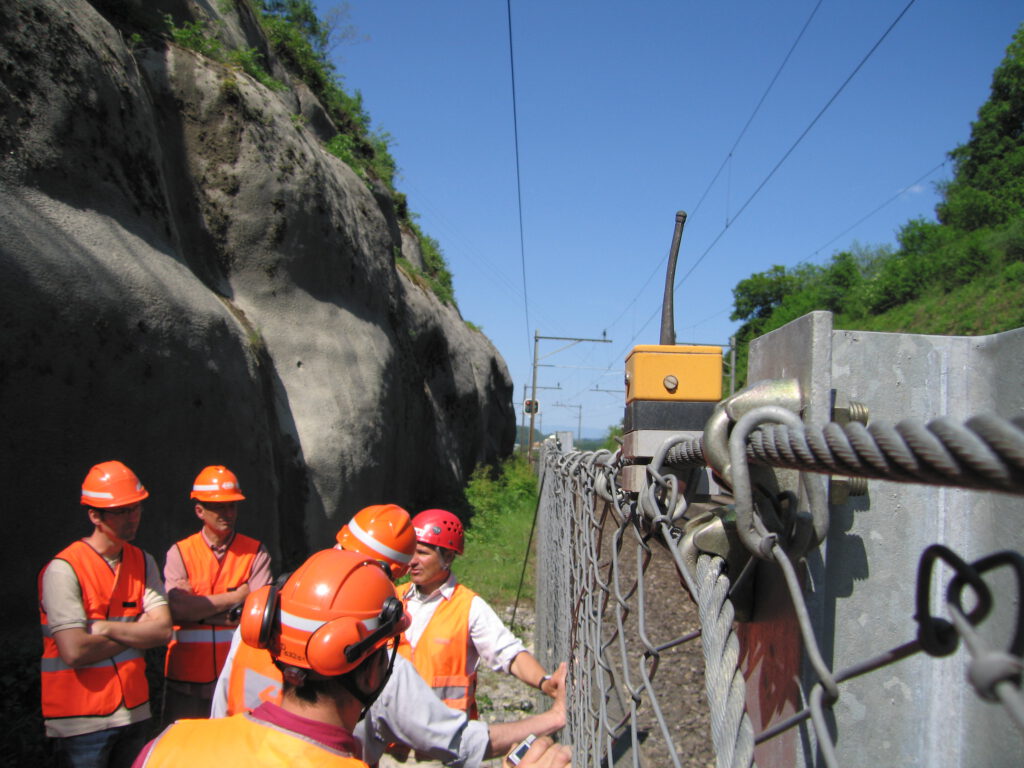
Rockfalls, landslides, and slope failures are increasing across Europe as climate change accelerates extreme rainfall, freeze–thaw cycles, and weather instability. For railways, mountain roads, hydro installations, and public infrastructure, reliable rockfall detection and geohazard monitoring are no longer optional—they’re essential.
Several technologies are promoted for detecting hazardous slope activity: Radar, Distributed Fibre Optic (DFO) systems, LiDAR, and physical barrier-mounted sensors like Impact Sentinel. Each can play a role, but their performance in real-world alpine environments varies dramatically.
This article presents a clear, evidence-based comparison drawn from field deployments, engineering evaluations, and documented system behaviour under extreme conditions.
While some newer technologies promise advanced capabilities, many fall short in real-world, safety-critical conditions. Impact Sentinel, one of the earliest systems deployed for railway rockfall detection, continues to perform year after year thanks to robust engineering, simplicity, and proven reliability.
1. Why Real-Time Rockfall Detection Matters
A detection system is only useful if it can:
-
Trigger immediate alarms
-
Operate reliably in storms, snow, fog, and darkness
-
Minimise false positives
-
Eliminate false negatives
-
Remain operational even when components fail
-
Communicate across long distances without interruption
In other words, safety-critical infrastructure requires zero-compromise reliability.
This is exactly where traditional technologies fall short—and where Impact Sentinel excels.
2. Rockfall Radar Systems: Powerful in Theory, Uncertain in Reality
Radar is often marketed as a cutting-edge solution for rockfall detection. It can monitor large slopes and detect pre-failure movement or falling objects.
But in real-world alpine environments, radar faces major limitations:
Weather Vulnerability
Radar performance declines severely in rain, fog, and snow—precisely when rockfall risk is highest. Signal attenuation leads to false positives or, worse, undetected events.
Line-of-Sight Restrictions
Radar cannot see through:
-
Terrain shadows
-
Vegetation
-
Tunnels or bends
-
Large boulders or infrastructure
Environmental Noise
Wildlife, wind-blown vegetation, trains, and maintenance vehicles all produce radar signatures that trigger false alarms.
Latency and Communication Delays
Many radar systems rely on 4G/5G or satellite pathways, producing delays of up to 20 minutes. This is not real-time alarming.
Lack of Redundancy
A single radar hardware issue or alignment problem can disable the entire monitoring zone.
Case in Point: Axenstrasse, Switzerland (2024)
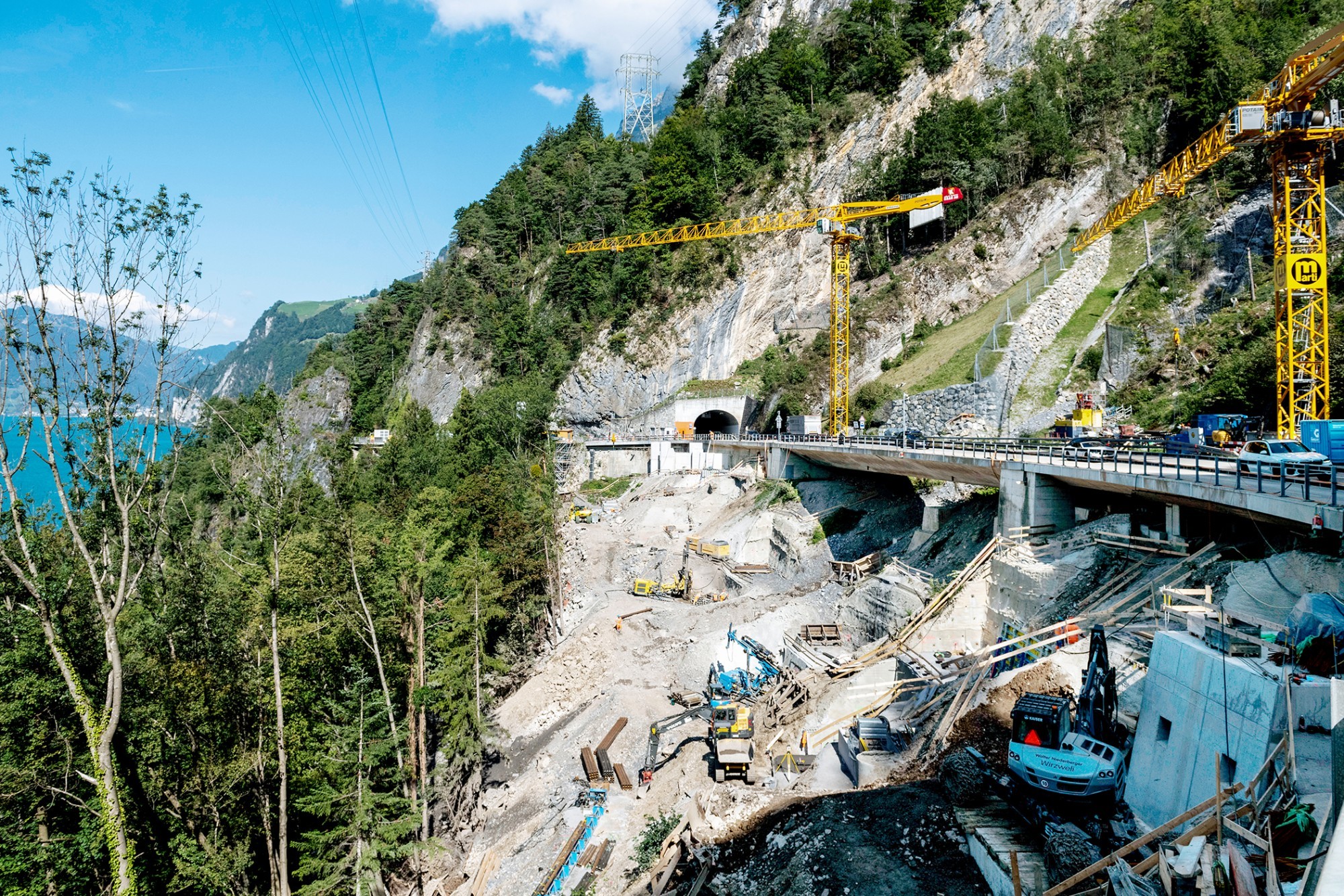
Image : Schwyz Civil Engineering Office
During an extreme weather event involving intense rainfall and storm conditions, a significant rockfall occurred along the Axenstrasse corridor. At the time, the site was protected by a multi-stage hazard management system, combining several monitoring technologies as part of a layered safety concept.
Within this setup, Impact Sentinel sensors installed directly on the protective barrier functioned as the final decision layer. Despite the severe weather conditions, the Impact Sentinel system successfully recognised the rockfall and associated geohazard movement in real time.
Upon detection, the system automatically triggered the predefined safety protocol, enabling rapid and reliable protective measures to be enacted without delay.
This event highlights the importance of direct, physical detection at the point of impact, particularly during extreme weather when environmental conditions can challenge remote or observational monitoring technologies. By operating independently of visibility, weather, and line-of-sight constraints, Impact Sentinel provided reliable, real-time alarming when it mattered most.
Summary: Radar is valuable for monitoring, but unreliable for real-time alarms.
3. Distributed Fibre Optic Systems: Excellent Coverage, Poor Event Certainty
DFO systems monitor vibrations along kilometres of fibre optic cable, appealing for long corridors such as railways.
But DFO technology has critical weaknesses for rockfall detection:
Low Sensitivity for Rockfall Events
Small rocks often do not generate enough ground vibration to be detected.
High False Positives
DFO systems frequently misinterpret:
-
Wildlife
-
Rainfall
-
Wind
-
Vegetation movement
-
Nearby machinery
Single Point of Failure
A single fibre break (from rock impact, frost, rodents, or equipment) can disable dozens of kilometres of monitoring.
Thermal Drift
Temperature changes cause signal distortion, requiring constant recalibration.
Spatial Resolution Limits
The system may detect “something happened” but not precisely where—potentially within several metres.
Unidirectional Sensitivity
If installed on one side of the track, rockfalls from the opposite slope may not couple energy into the fibre.
4. LiDAR: High-Tech but Highly Unreliable in Real Environments
LiDAR’s promise is 3D surface scanning—but for real-time hazard monitoring, it fails where it matters most.
Documented Weaknesses
-
Fog, rain, and snow scatter the laser beam
-
Vegetation interference distorts readings
-
Requires frequent calibration
-
Limited range and inconsistent data
In addition, LiDAR systems have very high power requirements and high cost. Continuous operation requires a permanent mains power supply (approximately 240 V), and LiDAR cannot realistically be operated using batteries or solar power, severely limiting its suitability for remote or alpine locations.
Due to these factors, LiDAR is rarely used as a primary real-time alarming solution for railway rockfall protection today. While costs may decrease over time, LiDAR currently remains a high-cost, high-power technology, best suited to analysis and surveying rather than continuous, safety-critical alarming.
5. Impact Sentinel: A Proven, Real-Time Geohazard Alarming System
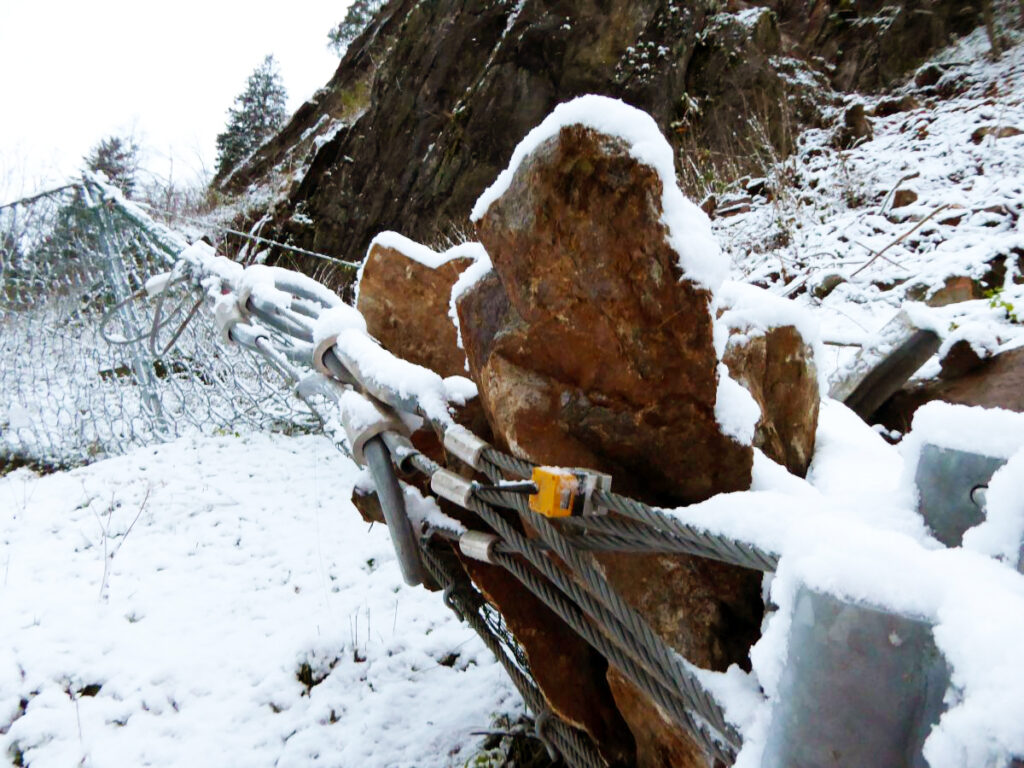
The Impact Sentinel is a wireless, combined rockfall and geohazard sensor that incorporates two complementary detection technologies within a single unit.
It integrates a MEMS (Micro-Electro-Mechanical System) module for continuous, real-time monitoring of vibration, movement, and tilt, together with a patented physical breakage mechanism that triggers an alarm once a defined force threshold is exceeded.
By combining electronic sensing with mechanical threshold-based detection, Impact Sentinel delivers a multi-layered detection concept that significantly enhances reliability. This dual approach ensures that both gradual geohazard movement and sudden high-energy rockfall events are detected with high confidence, even under extreme environmental conditions.
Unlike radar, fibre optics, or LiDAR, Impact Sentinel is installed directly on the protective barriers or fences—the place where rockfalls make physical contact.
This eliminates ambiguity and ensures perfect coupling between the event and the sensor.
5.1 Real-Time Event Detection (2–4 seconds)
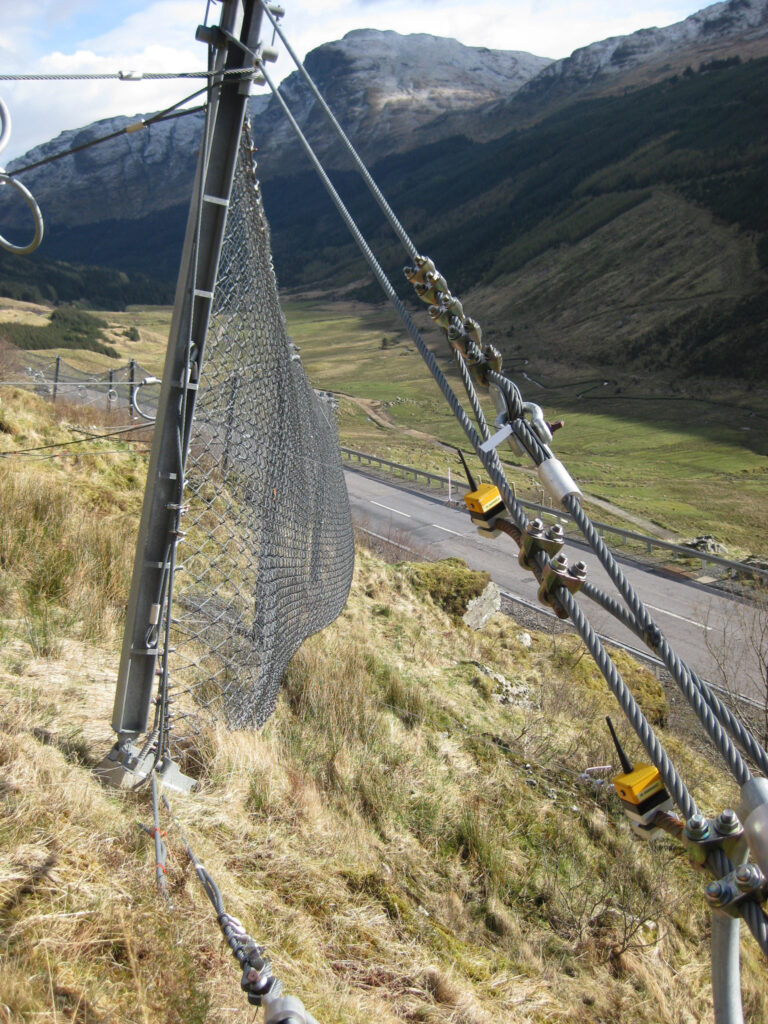
Impact Sentinel processes signals instantly and communicates alarms within seconds. This is critical for railway operations and automated closure systems.
5.2 Triple Redundancy Architecture
Impact Sentinel is engineered with:
-
Monitoring redundancy (multiple sensors covering each barrier section)
-
Network redundancy (multiple relays/base stations)
-
Communication redundancy (RF, LAN, GSM, fibre, 3G/4G/5G)
If any component fails, the system reroutes data automatically.
5.3 Immune to Weather and Environmental Interference
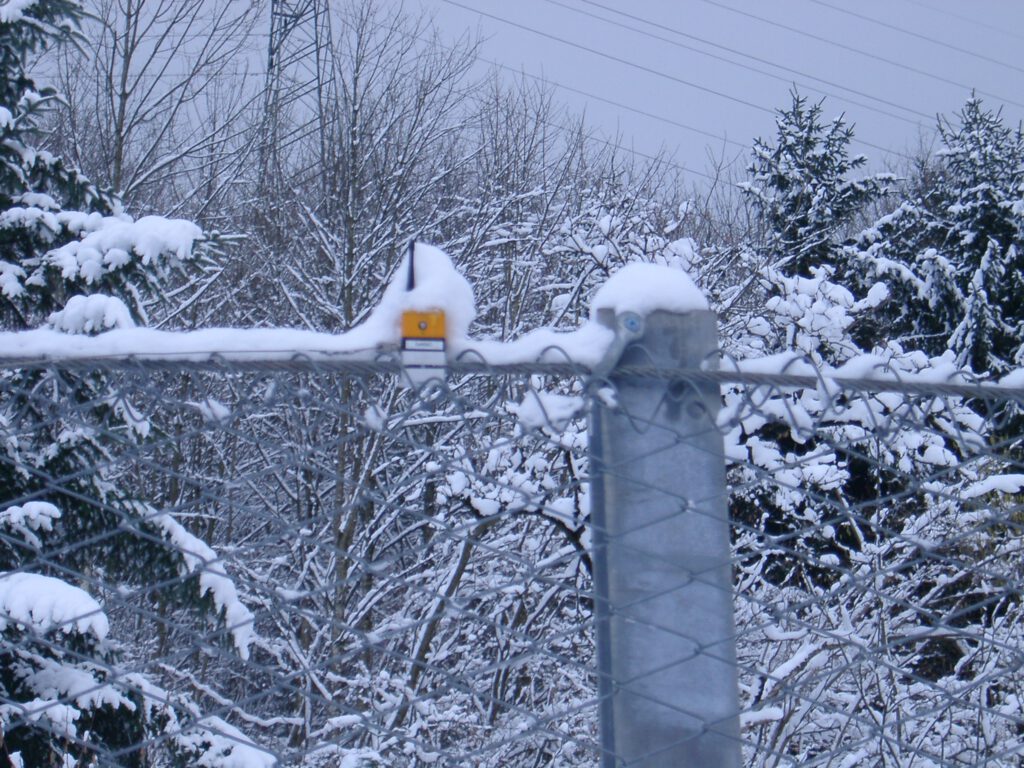
Because detection is physical—not optical or line-of-sight—Impact Sentinel is unaffected by:
-
Rain
-
Snow
-
Fog
-
Darkness
-
Vegetation
-
Wildlife
-
Storms (as demonstrated in Axenstrasse 2024)
5.4 Multi-Mode Detection
Each sensor measures:
-
Pull-out displacement (direct barrier breach)
-
Impact force (vibration/acceleration)
-
XYZ tilt (slow movement, snow load, structural deformation)
-
Temperature and health metrics
This ensures extraordinary sensitivity with no documented false negatives.
5.5 Long-Distance Communication Reliability
Impact Sentinel employs:
-
Multi-relay RF architecture
-
GSM/4G and satellite backup
-
Zero data loss across mountain terrain
-
Reliable operation in extreme weather
-
Autonomous solar-powered nodes
By combining direct physical detection, real-time alarming, and built-in redundancy, Impact Sentinel provides infrastructure operators with what matters most — a system they can trust to work when conditions are at their worst.
Impact Sentinel can monitor remote alpine zones where other systems fail.
6. Comparison at a Glance
(Insert comparison table here)
7. Conclusion: Impact Sentinel Delivers True Safety-Critical Reliability
Radar, fibre optic, and LiDAR systems each have value in monitoring. But when safety depends on instant, accurate, failure-resistant alarming, only one system consistently performs:
Impact Sentinel
It is:
-
Real-time
-
Redundant
-
Weather-proof
-
Field-proven
-
Low-maintenance
-
Highly scalable
-
Highly cost effective
-
Designed specifically for rockfall & geohazard protection
👉 Impact Sentinel remains the most reliable, real-time alarming technology for rockfall detection and geohazard monitoring.
In the evolving landscape of geohazard monitoring, reliability and clarity of data are paramount. While radar, DFO, and LiDAR each contribute valuable insights, their complexity, cost, and environmental limitations restrict their use in continuous, safety-critical applications.
Impact Sentinel stands out as a proven, field-tested solution that delivers real-time detection, operational simplicity, and long-term resilience. For infrastructure operators seeking dependable protection against rockfalls and slope failures, Impact Sentinel continues to set the standard for real-world geohazard monitoring.
Find us here : https://inglas.org/rockfall-landslide-detection/
