
Overview
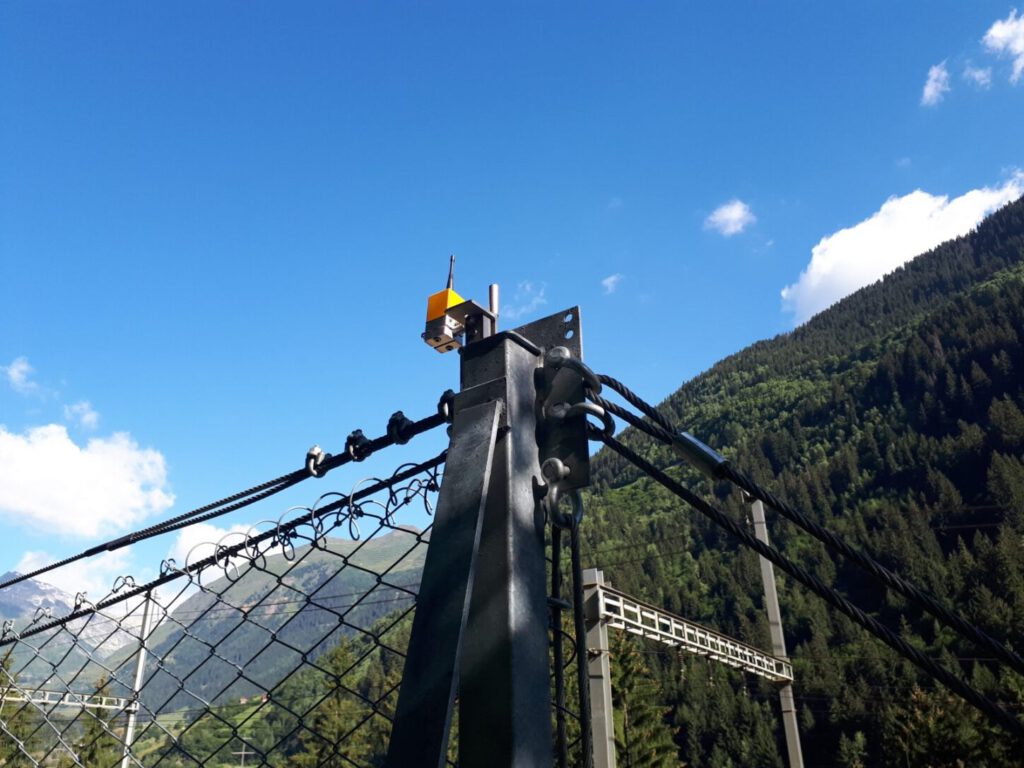
Low KJ Rockfall & Natural Hazard Monitoring Sensor along rail tracks in Switzerland
Not every hazard requires a high-energy rockfall barrier—but even low-energy fences can face regular stress from smaller events such as debris flows, shallow slides, or minor rock impacts.
Monitoring these systems ensures they remain functional and efficient without unnecessary maintenance or replacement.
The goal: to provide continuous, real-time monitoring for low KJ barriers that are often installed in residential areas, road corridors, or near infrastructure where smaller-scale incidents can still pose significant risks.
The Challenge
Low KJ barriers, while cost-effective and flexible, can degrade gradually through repeated low-impact loading and environmental wear.
Visual inspections alone can miss early signs of material fatigue or structural distortion.
Engineers needed a monitoring approach capable of:
-
Detecting impacts too minor to be noticed manually
-
Tracking cumulative load effects
-
Remaining simple and affordable for smaller-scale installations
The Solution
The Impact Sentinel system was adapted for use on low-energy barriers, offering the same reliability and accuracy as large-scale installations but in a compact, economical configuration.
Each barrier segment is equipped with wireless sensors capable of:
-
Measuring impact acceleration and tilt
-
Logging cumulative deformation
-
Sending real-time alerts via SMS, email, or dashboard
The system is powered by long-life Li batteries and can operate autonomously for years with minimal maintenance.
The collected data are visualized through the SAM interface, which displays both impact frequency and force intensity across the network.
Results
Field deployments demonstrated that even light debris impacts register clear, repeatable signals.
By analyzing this data, engineers identified zones of repeated stress and targeted them for reinforcement—eliminating the need for full barrier replacements.
The system also proved ideal for municipal or small-scale projects, where cost and simplicity are key.
Its modular design means it can scale up seamlessly to larger installations if conditions evolve.
Conclusion
Low KJ barrier monitoring bridges the gap between passive protection and active safety management.
By combining affordability with intelligent sensing, the Impact Sentinel system transforms even modest barrier systems into connected, data-driven assets, ensuring readiness and reliability where it matters most.
