
Geohazard monitoring in extreme heat has become a frontline concern for Europe's railways. The hardware meant to catch a rockfall is now exposed to the very conditions most likely to degrade it. So what does "extreme-weather capable" actually require? This article answers that, and shows how ImpactSentinel™ performs against it.
The problem: infrastructure built for a cooler Europe
Europe's rail network was largely engineered for a climate that no longer exists in summer. In 2026, however, successive heatwaves have pushed air temperatures above 44°C in parts of France, Spain, and Germany, and, as a result, national rail operators are cancelling services and reporting track deformation from thermal expansion. Furthermore, a UN Economic Commission for Europe assessment released recently projects a sharp rise in hot days. The network will face 10 to 50 extra days per year above 25°C. In fact, 90% of the European rail network will gain an extra 10 days above 32°C by 2050–2080.
This isn't a future risk. Instead, it's operational now, and it's compounding. dry soil from repeated heatwaves absorbs and radiates heat faster than moist ground, meaning each subsequent heat event tends to hit harder than the last. For anyone responsible for extreme heat railway infrastructure, the question is no longer whether monitoring hardware will face these conditions, but how well it holds up when it does.
Extreme heat is no longer an edge case to plan around once a decade — it's a recurring operating condition, and the monitoring hardware has to be rated for it.
— The core principle for heat-resilient railway monitoring
Why geohazard monitoring in extreme heat matters beyond passenger comfort
Heat stress on infrastructure isn't limited to buckling rails. Two consequences matter directly for railway geohazard monitoring:
- The monitoring hardware itself has to keep working. Sensors mounted on exposed barriers, cuttings, and slopes sit in direct sun with no climate control. If a system's thermal tolerance is marginal, the exact conditions that increase geohazard risk are the conditions most likely to degrade or blind the monitoring meant to catch it — which is why extreme-temperature monitoring sensors are rated so carefully.
- Slope risk doesn't pause for heat. Thermal cycling stresses rock joints, drought reduces cohesion in slope material, and burned ground from wildfire — a rising risk this season — loses the root structure that stabilizes slopes. Germany has already seen a 16,000m³ rockfall close a major freight route for seven weeks. Heat-driven slope events are a distinct risk category from the rainfall-triggered events most rockfall content focuses on, making rockfall monitoring in extreme weather a category of its own that becomes more relevant every summer.
What geohazard monitoring in extreme heat actually requires
Not all monitoring hardware is rated the same way, and specs are often quoted without context. For rail-adjacent, exposed infrastructure equipment, the relevant benchmarks are:
What a heat-capable monitoring system must deliver
- Operating temperature rangeThe full range the unit is rated to function in, not just survive. This is the single most important geohazard sensor operating temperature figure to check.
- Ingress protection ratingSealing against dust and water at high ambient temperature, when seals and gaskets are under the most thermal stress.
- Formal rail equipment standardsA recognised certification — not just a manufacturer's internal spec sheet.
- Power architectureMains-dependent systems carry a heat-driven failure mode (grid strain, cooling load) that battery/solar systems don't.
- Self-reporting health dataA system that can't tell you its own condition during an extreme event is asking you to trust it blindly at the worst possible time.
ImpactSentinel™ specifications
| Spec | Value |
|---|---|
| Operating temperature range | −20°C to +60°C (ImpactSentinel core) / −40°C to +60°C (W400 series) |
| Ingress protection | IP67-sealed enclosure |
| Standard | EN 50155 (IEC 60571) — shock, vibration, temperature range, EMC for rail equipment |
| Radio certification | CE/UKCA, LoRaWAN; EU RED 868 MHz (W400) |
| Power | Battery / solar — no mains dependency, no active cooling requirement |
| Self-monitoring | Continuous reporting of sensor temperature, voltage, and RSSI alongside hazard data |
| Alarm speed | 2–4 seconds from trigger to alarm, unaffected by ambient conditions |
Geohazard monitoring in extreme heat: field history, not a lab claim
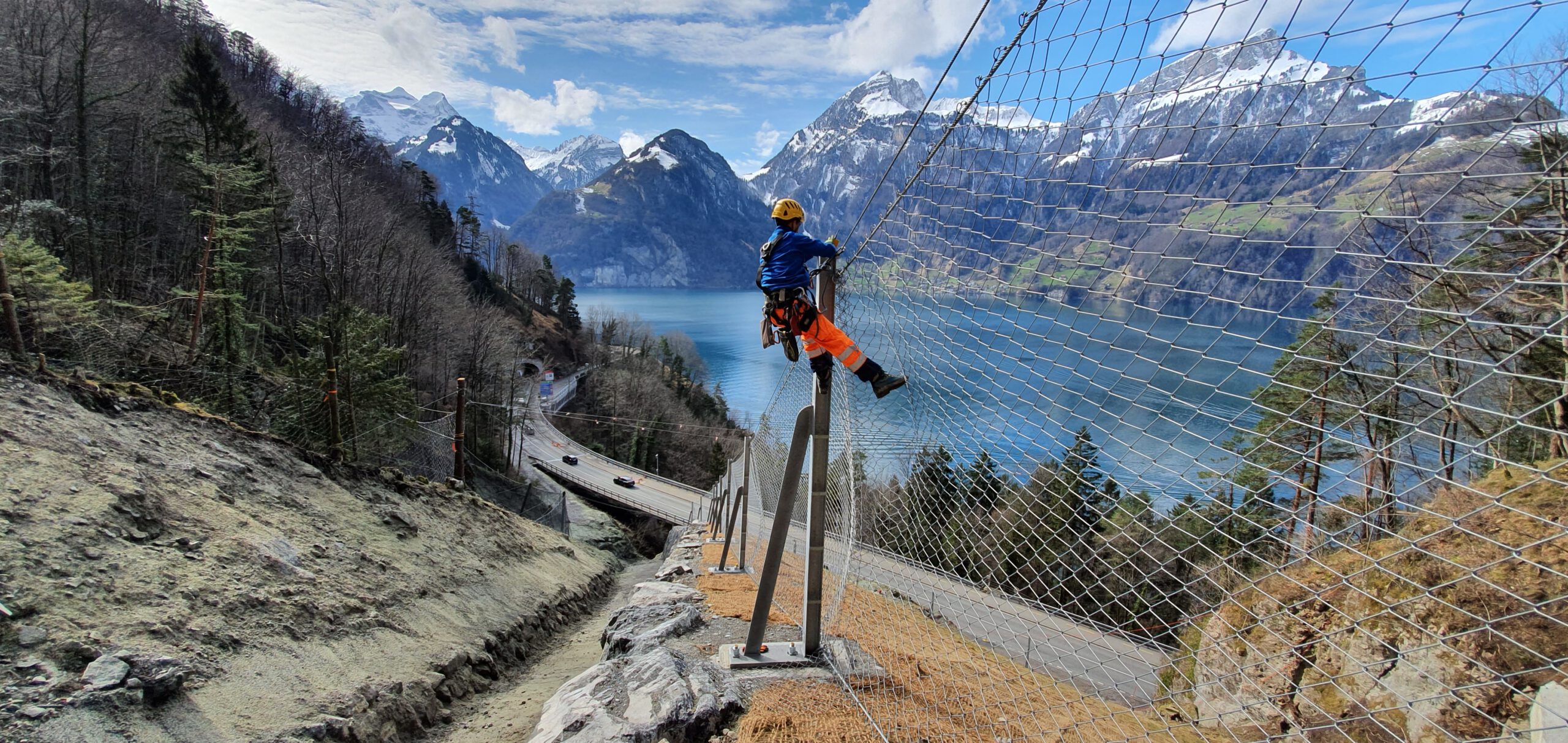
ImpactSentinel™ has operated continuously at the Gotthard rail line with Swiss Federal Railways (SBB) for more than a decade — through Alpine winters and, increasingly, through summers that now regularly exceed historical records. For example, during the 2024 Axenstrasse event, the system acted as the final decision layer in severe weather.In short, the system has proven itself across the full range of conditions it is rated for, not just the ones that are easy to test in a lab.
Specifying monitoring for a hot-climate site?
Get in touch for a briefing on deployment for your specific line, slope, or portal.
Related reading: Cold Weather performance (companion piece) · Rockfall Detection Technologies Compared
Geohazard monitoring in extreme heat: FAQ
ImpactSentinel™ core units operate from −20°C to +60°C; the W400 series extends this to −40°C to +60°C, certified to EN 50155 for rail equipment.
Hardware not rated for sustained high ambient and surface temperatures can degrade. Specifically, seals, batteries, or communication links can fail. ImpactSentinel™ is IP67-sealed and continuously reports its own temperature and voltage alongside hazard data, so operators relying on rockfall detection sensors can verify system health directly.
Yes. Thermal cycling stresses rock joints, drought reduces slope cohesion, and wildfire-affected slopes lose stabilizing root structure — all of which are heat-driven risk factors distinct from rainfall-triggered rockfall events, and central to railway slope monitoring.
Both. Specifications are certified to EN 50155, and the system has an active field record spanning over a decade at the Gotthard rail line, including performance during the 2024 Axenstrasse extreme weather event.
